Case Study 05 · E‑commerce · 2021

The Black Tux

Rebuilding the primary e‑commerce funnel for event‑based formal wear — as a team of one grew into a design org latticed across three subsystems.

Role
Head of Product Design
Led process, research & execution
Team
3 Product Designers
3 Product & 14 Eng partners
Platform
Web — e‑commerce
Scope
Primary funnel, end to end
01 — Context
Where the business
stood when I joined

Pent‑up wedding demand was arriving — and the site wasn't ready to capture it.

The Black Tux rents and sells event‑based formal wear for wedding parties. I joined in early 2021, inheriting a single product designer.

Coming out of COVID‑19 lockdown, pent‑up demand for weddings was accelerating growth. I was brought on to build the design team and prepare the product to capture that demand and maximize revenue.

02 — Problem
Five drags
on revenue

An overburdened funnel that couldn't express the business's own levers.

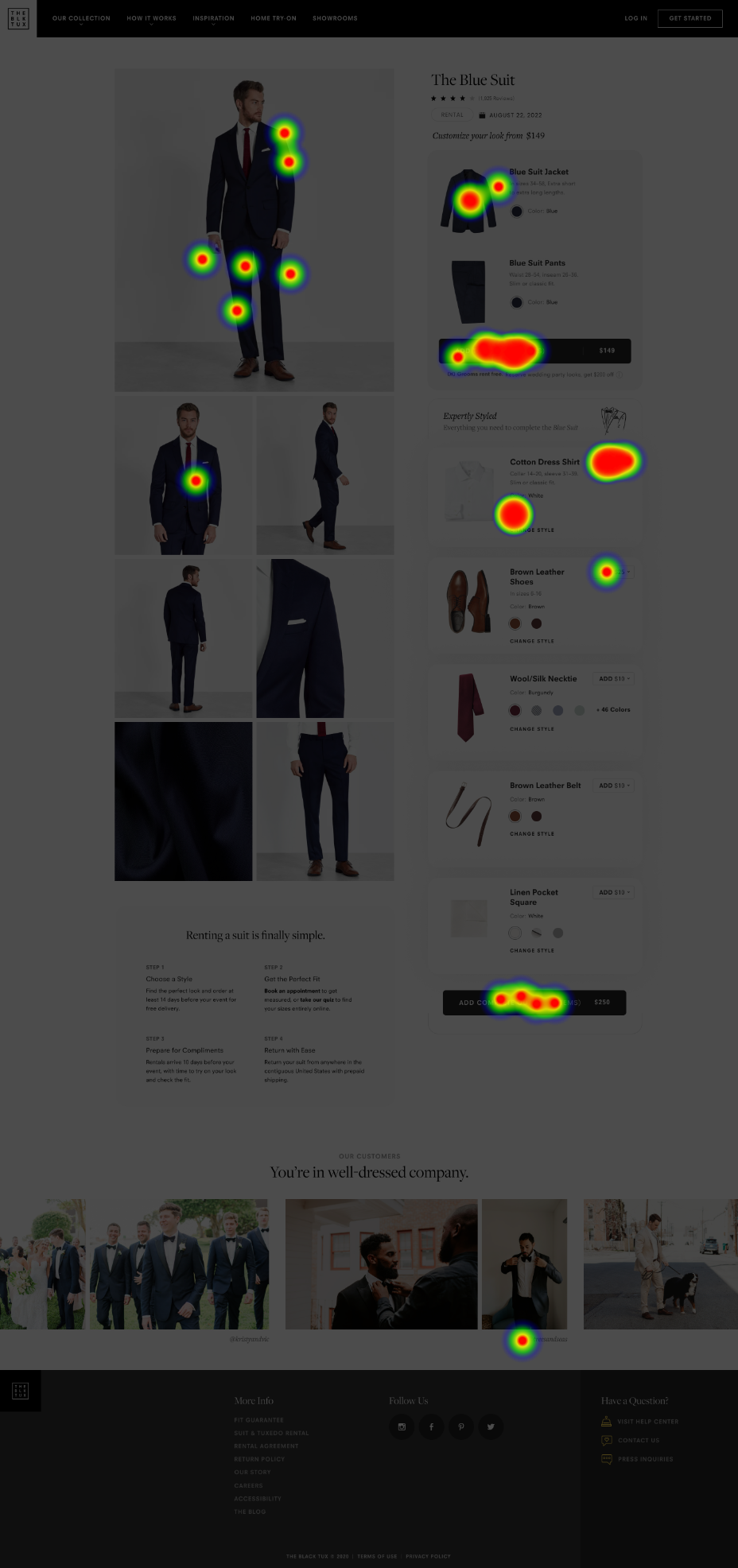
  1. Funnel flows were overburdened with featuresYears of additions had piled onto the core flows, blurring the paths to purchase.
  2. Inventory limits stopped at the style levelConstraints couldn't be expressed on SKUs — sizes within a style — limiting merchandising and inventory control.
  3. Site order size lagged the showroomAverage order size online trailed far behind what showrooms achieved with the same customers.
  4. Purchase stayed flat while rental grewThe for‑purchase business wasn't participating in the company's growth.
  5. Grooms and groomsmen got uneven experiencesParty creators and participants moved through flows of uneven quality — with uneven performance to match.
03 — Objectives
What success
had to look like

Grow the site's contribution to revenue — and hand the business finer controls.

  1. Increase the site's contribution to revenueMeasured through conversion, average order size, and average contract value.
  2. Build fine‑tuned leversGive inventory management, merchandising, marketing, and conversion optimization the controls the old funnel couldn't express.
04 — Process
How the work
was run

Discovery to refinement, with the domain split into three subsystems.

01 — Discovery
Strategy, questions, KPIs
Design strategy, formulated questions, set KPIs, gathered data and previous research.
02 — Exploration
Ideation, IA & validation
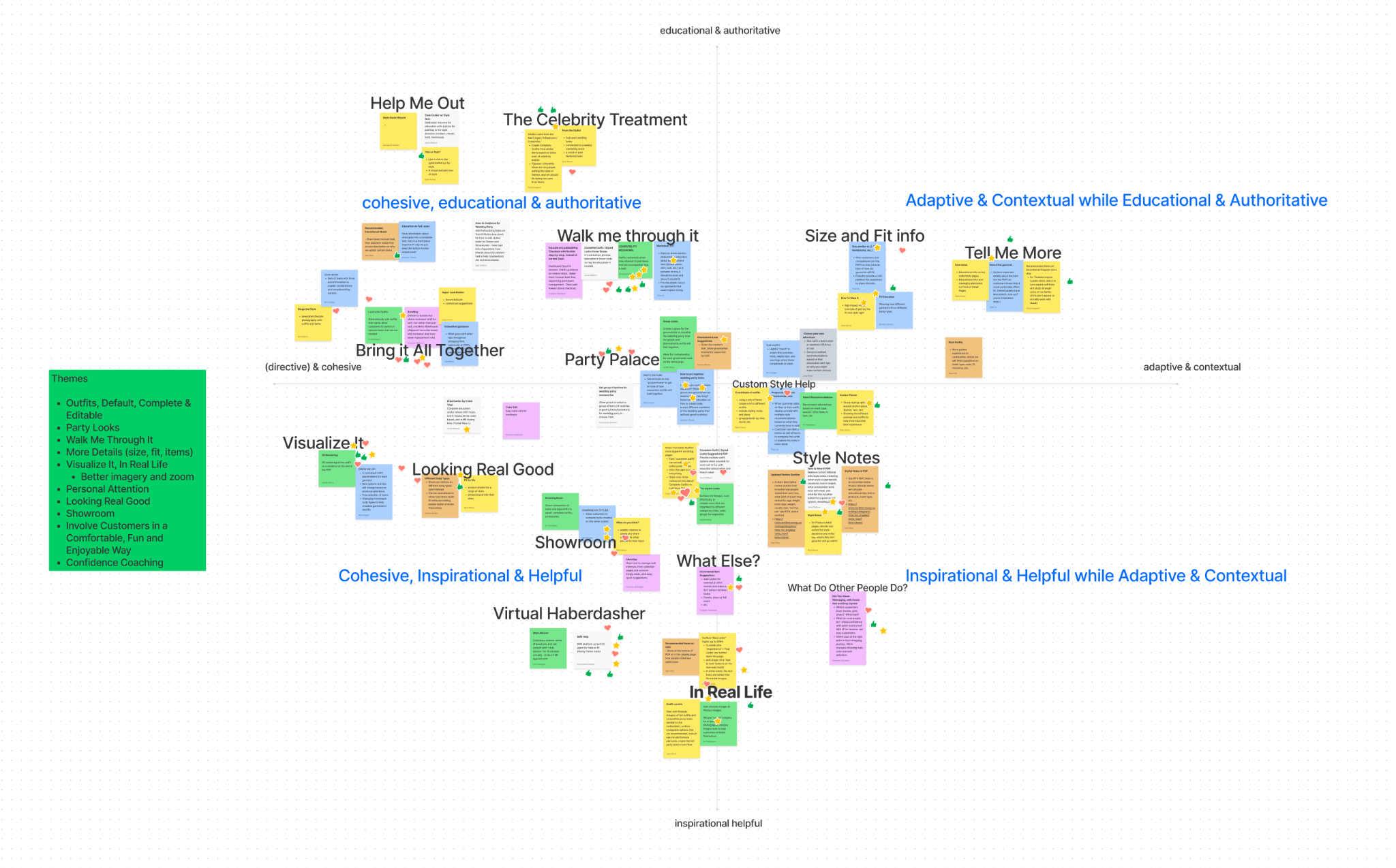
Structured brainstorming, shadowing, tiger teams, information architecture, prototyping and user testing.
03 — Execution
Lockups, specs & roll‑out
Page lockups, design‑system components, key states and edge cases, redlines, strategic roll‑out planning.
04 — Refinement
Test, measure, iterate
A/B testing of the MVP against target outcomes, refined toward the KPIs.
Three semi‑independent subsystems
Subsystem
Drives
Paired design team
Decision Architecture
Conversion & AOV
Sr Product Designer + Product Designer
Funnel Mechanics
Conversion & AOV
Lead Product Designer + Product Designer
Party Building
Avg Party Size & AOV
Lead Product Designer + Sr Product Designer
Research that changed what got built

Unmoderated first‑click, 5‑second tests, and design surveys gave quick signal on card anatomy, micro‑copy, and price presentation. The design team recruited 10 in‑market users for interviews — wrote the discussion guide, led the sessions, and presented findings on buy‑vs‑rent decisions, customization, comparing choices, and price perception directly to stakeholders.

Stakeholders
CEOCSOCMOHead of ProductDir. EngineeringDir. Merchandising
05 — Outcome

The MVP beat its targets in A/B — on the metrics the business runs on.

Results from A/B test of the MVP, against target
+9.8%
Average contract value
Target: +2.5%
+14.2%
Conversion rate
Target: steady or increase
+2.1
Items per average order
Target: +2 items
Steady
Average party size
Target: +0.7
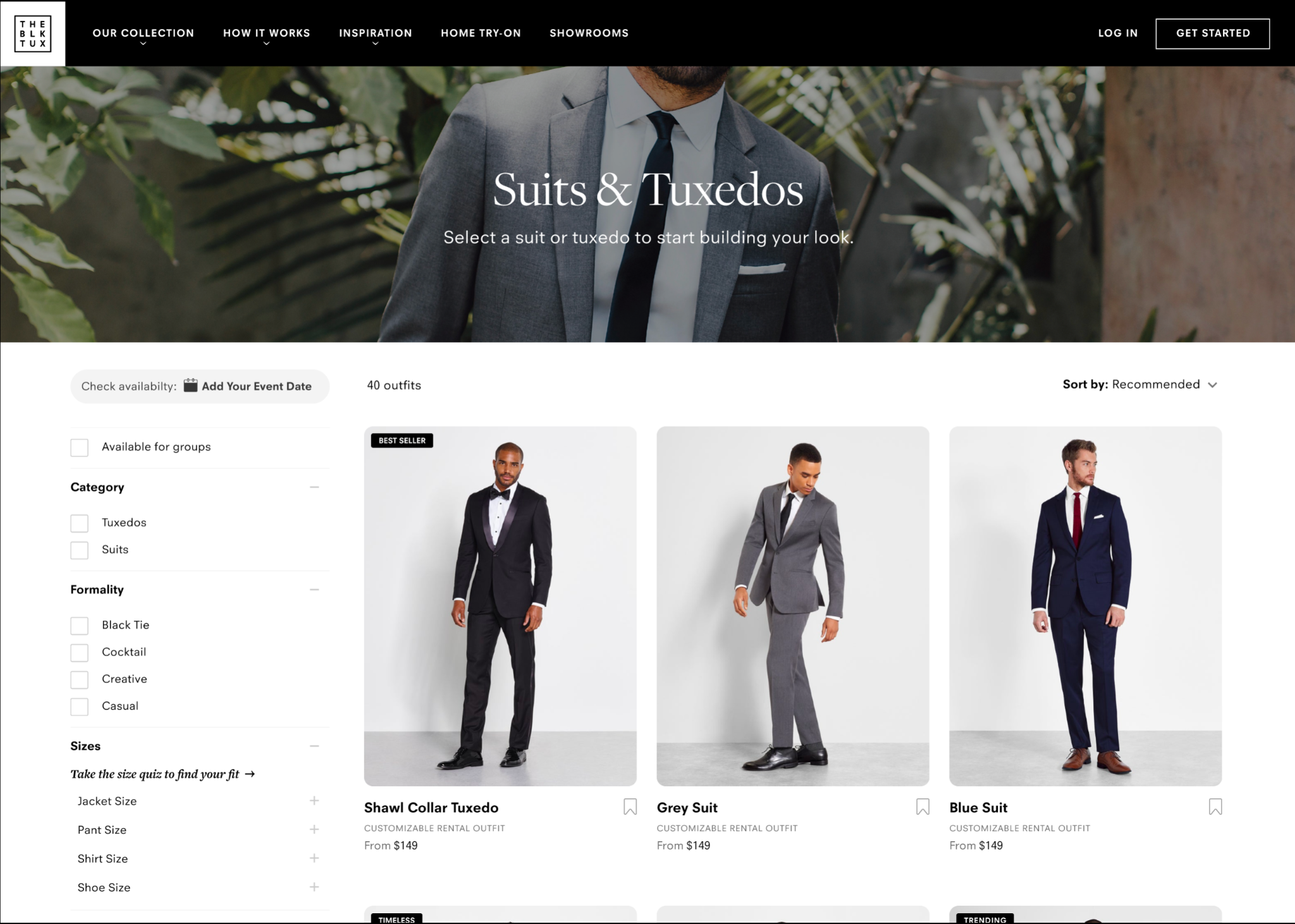
Redesigned Suits & Tuxedos collection page
Collection page — Suits & Tuxedos
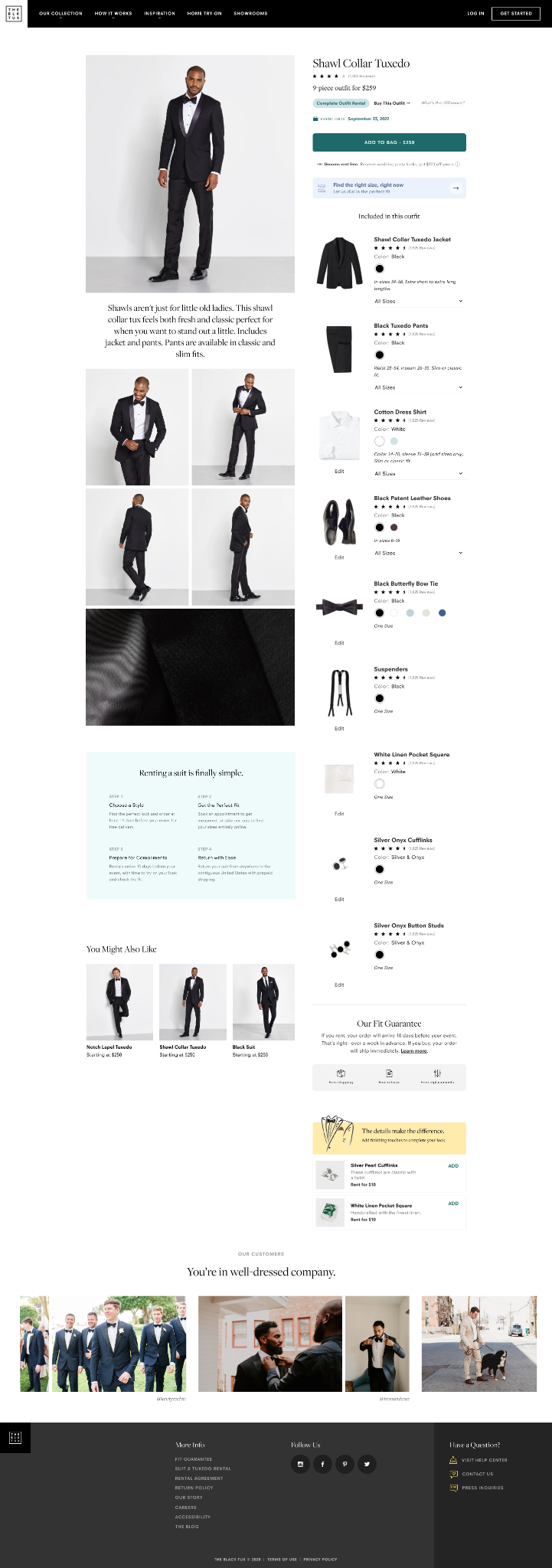
Redesigned product page — Shawl Collar Tuxedo
Product page — outfit builder